# Association Testing in Related Individuals
Family data is correlated that could lead to inflation in test statistics if not accounted for. Many genetic studies contain related individuals. Family-based studies were developed to avoid bias due to population structure; Biological family members are genetically matched.
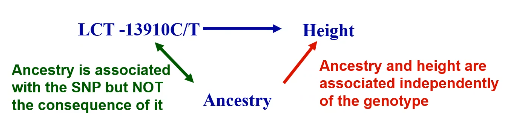
Most behavioral and environmental factors do not alter DNA, so SNP associations are unlikely to be confounded EXCEPT confounding by ancestry.
[](https://bookstack.mitchellhenschel.com/uploads/images/gallery/2022-11/image-1667394044217.png)
#### Population Stratification Bias
- For case control studies, population structure means bad matching; cases and controls come from different genetic populations.
- For cohort/cross-sectional studies with quantitative phenotypes, if the phenotype and genotype distributions both differ by population then population stratification bias can occur.
- If a population consists of a mixture of subpopulations and it is not accounted for in the analysis, false evidence for association may result.
- Spurious association only occurs when there is a difference in BOTH genotype and phenotype distribution with subpopulations.
### Designs for Family-Based Studies
- Early-onset phenotypes:
- Case-parent trios (where child is effected) - Transmission disequilibrium test (TDT)
- Late-onset phenotypes:
- Discordant siblings - sub-TDT/conditional logistic regression
- General designs
- Nuclear or extended families - Family-based association test (FBAT)
We'll mostly focus on case-parent trios and TDT tests.
#### Case-Parent Trios
In this design we collect samples of trios; Two parents and one affected child (affection status of parents are not considered). The idea is under Mendels laws, heterozygous parents transmit each allele with equal probability (1/2) regardless of population structure. If there is preferential transmission of a specific allele from parents to affected offspring it indicates that allele is associated with the disease.
#### Transmission Disequilibrium Test (TDT)
Tests whether a particular marker allele is transmitted to affected offspring more frequently than expected. Non-transmitted alleles act as matched controls.
H0: No association or no linkage
Ha: Variant is associated with disease/trait (and is not due to population structure)
##### Notation:
[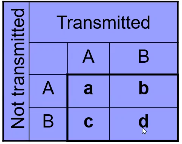](https://bookstack.mitchellhenschel.com/uploads/images/gallery/2022-11/image-1667395369592.png)
- a = number of AA parents
- b + c = number of AB parents
- b = Number of AB parents transmitting B to affected child
- c = Number of AB parents transmitting A to affected child
- d = number of BB parents
Under the null we would expect:
[](https://bookstack.mitchellhenschel.com/uploads/images/gallery/2022-11/image-1667395321311.png)
[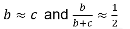](https://bookstack.mitchellhenschel.com/uploads/images/gallery/2022-11/image-1667395351114.png)
The test statistic follows a McNemar test:
[](https://bookstack.mitchellhenschel.com/uploads/images/gallery/2022-11/image-1667395577062.png)
We observe this is only a function of the heterozyzgous parents, homozygous parents provide no information.
#### Discordant Siblings
- TDT unit of analysis is affected child + parents.
- Discordant siblings - unit of analysis is sibships with at least one affected and one unaffected sibling
- Analysis possibilities:
- Cochram-Maentel-Haenszel test
- Conditional Logistic Regression
- Like TDT these tests are conditioning on the genotypes in the family
- TDT: conditioning on the parent's alleles
- Sibs: conditioning on the observed genotypes in the sibship
#### General Family Structures
- Family Based Association Test (FBAT) and other similar tests (requires specialized software)
- Determine the expected genotypes of the affected individuals conditional on the family structure
- Use this to create a score test comparing observed and expected genotypes
- Same idea as parent-offspring trios or case-control sibships: conditioning on the observed genotypes
### Unconditional Tests
- TDT, sTDT, FBAT and other family based association tests are conditional tests
- These tests are immune to population structure bias but often ignore information that can be used to assess association when population structure is not a concern
- Homozygous parents
- Sibships where the case and control have the same genotype
- Modern analyses can account for population structure using ancestry information available with genome-wide data
- Unconditional analyses account for the family correlation and make use of all the observed data
- These analyses tend to be more powerful than the conditional family-based tests
**Review**: For unrelated (independent) subjects we can use standard linear or logistic regression. Including related individuals in the analysis violates the assumption of independence, causing inflation in the test statistics.
[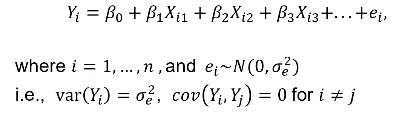](https://bookstack.mitchellhenschel.com/uploads/images/gallery/2022-11/image-1667397203470.png)
Where Xi1 is the genotype of the ith person and beta1 is the fixed affect of the SNP. Xi2 and Xi3 are covariates.
**For related data** there are specific methods we can use:
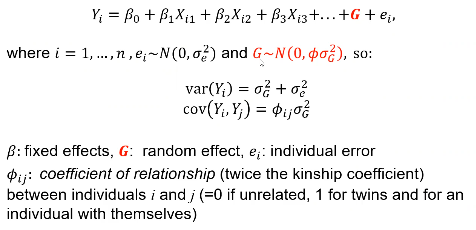
- For quantitative traits use Linear mixed effects models are frequently used for corrected observations for an individual or related individuals.
- Pedigree-specific methods use a variance component that is dependent on the kinship matrix for individuals.
[](https://bookstack.mitchellhenschel.com/uploads/images/gallery/2022-11/image-1667397383331.png)
We can see the mixed effects model adds a G variable to account for genetic variance component.
For association analysis of quantitative traits, if X1 is the SNP then the test H0: Beta1 = 0 is a test of association just as for the linear model for unrelated subjects. The regression estimate beta is exactly the same as in simple linear regression.
In either case G is not tested for significance. If we want to test for heritability we estimate variance of G.
Common software: GCTA, SOLAR, R GMMAT package, Genesis R/Bioconductor package.
##### Dichotomous Traits
- Logistic mixed effects can be used to account for relationships
- Fit using penalized quasi-likelihood method
- Requires iterative matrix inversion - can be very slow
- Alternative: Logistic model with Generalized Estimating Equations (GEE)
- Accounts for correlated observations in a general way
- Produces a "robust" variance estimate to account for correlation
- Tends to result in inflated Type-I error
- Low frequency SNPs primary probelm
- Extent of inflation varies
In this course we focus on quantitative traits to keep things simple.