# Bayesian Linear Regression

By now we know what a linear regression looks like. Let's consider a special case where number of parameters, p = 0:  
[![image.png](https://bookstack.mitchellhenschel.com/uploads/images/gallery/2023-02/scaled-1680-/4jbimage.png)](https://bookstack.mitchellhenschel.com/uploads/images/gallery/2023-02/4jbimage.png)  
Assume Y is distributed as a normal distribution with mean <span dir="ltr" role="presentation" style="left: 34.36%; top: 24.8%; font-size: calc(var(--scale-factor)*9.96px); font-family: sans-serif;">β</span><sub>0</sub>:  
<span dir="ltr" role="presentation" style="left: 14.46%; top: 47.91%; font-size: calc(var(--scale-factor)*9.96px); font-family: sans-serif;"> Y</span><span dir="ltr" role="presentation" style="left: 14.93%; top: 47.91%; font-size: calc(var(--scale-factor)*9.96px); font-family: sans-serif;">|</span><span dir="ltr" role="presentation" style="left: 15.7%; top: 47.91%; font-size: calc(var(--scale-factor)*9.96px); font-family: sans-serif;">β</span><sub><span dir="ltr" role="presentation" style="left: 17.25%; top: 49.3%; font-family: sans-serif;">0</span></sub><span dir="ltr" role="presentation" style="left: 18.41%; top: 47.91%; font-size: calc(var(--scale-factor)*9.96px); font-family: sans-serif; transform: scaleX(0.712076);">, τ</span><span dir="ltr" role="presentation" style="left: 20.83%; top: 47.91%; font-size: calc(var(--scale-factor)*9.96px); font-family: sans-serif;"> </span><span dir="ltr" role="presentation" style="left: 21.9%; top: 47.91%; font-size: calc(var(--scale-factor)*9.96px); font-family: sans-serif;">∼</span><span dir="ltr" role="presentation" style="left: 24.04%; top: 47.91%; font-size: calc(var(--scale-factor)*9.96px); font-family: sans-serif;"> </span><span dir="ltr" role="presentation" style="left: 24.8%; top: 47.91%; font-size: calc(var(--scale-factor)*9.96px); font-family: sans-serif;">N</span><span dir="ltr" role="presentation" style="left: 26.96%; top: 47.91%; font-size: calc(var(--scale-factor)*9.96px); font-family: sans-serif;">(</span><span dir="ltr" role="presentation" style="left: 28.03%; top: 47.91%; font-size: calc(var(--scale-factor)*9.96px); font-family: sans-serif;">β</span><sub><span dir="ltr" role="presentation" style="left: 29.58%; top: 49.3%; font-family: sans-serif;">0</span></sub><span dir="ltr" role="presentation" style="left: 30.74%; top: 47.91%; font-size: calc(var(--scale-factor)*9.96px); font-family: sans-serif; transform: scaleX(0.799684);">, σ</span><sup><span dir="ltr" role="presentation" style="left: 33.63%; top: 47.24%; font-family: sans-serif;">2</span></sup><span dir="ltr" role="presentation" style="left: 34.65%; top: 47.24%; font-size: calc(var(--scale-factor)*6.97px); font-family: sans-serif;"> </span><span dir="ltr" role="presentation" style="left: 35.55%; top: 47.91%; font-size: calc(var(--scale-factor)*9.96px); font-family: sans-serif;">=</span><span dir="ltr" role="presentation" style="left: 37.69%; top: 47.91%; font-size: calc(var(--scale-factor)*9.96px); font-family: sans-serif;"> </span><span dir="ltr" role="presentation" style="left: 38.45%; top: 47.91%; font-size: calc(var(--scale-factor)*9.96px); font-family: sans-serif;">1</span><span dir="ltr" role="presentation" style="left: 39.82%; top: 47.91%; font-size: calc(var(--scale-factor)*9.96px); font-family: sans-serif; transform: scaleX(0.997537);">/τ</span><span dir="ltr" role="presentation" style="left: 42.4%; top: 47.91%; font-size: calc(var(--scale-factor)*9.96px); font-family: sans-serif;"> </span><span dir="ltr" role="presentation" style="left: 42.71%; top: 47.91%; font-size: calc(var(--scale-factor)*9.96px); font-family: sans-serif;">)  
</span>

<p class="callout warning"><span dir="ltr" role="presentation" style="left: 7.32%; top: 34.44%; font-size: calc(var(--scale-factor)*9.96px); font-family: sans-serif;">τ</span> = 1 / <span dir="ltr" role="presentation" style="left: 18.01%; top: 29.2%; font-size: calc(var(--scale-factor)*9.96px); font-family: sans-serif;">σ<sup>2</sup> , also called **precision** &lt;- Be aware this will be used interchangeably with variance  
</span></p>

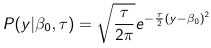
<span dir="ltr" role="presentation" style="left: 18.01%; top: 29.2%; font-size: calc(var(--scale-factor)*9.96px); font-family: sans-serif;">The density function is:  
</span>[![image.png](https://bookstack.mitchellhenschel.com/uploads/images/gallery/2023-02/scaled-1680-/ByOimage.png)](https://bookstack.mitchellhenschel.com/uploads/images/gallery/2023-02/ByOimage.png)  
Mean and variance:  
E(Y) = <span dir="ltr" role="presentation" style="left: 63.65%; top: 63.14%; font-size: calc(var(--scale-factor)*9.96px); font-family: sans-serif;">μ</span><sub>0</sub>; V(Y) = 1/<span dir="ltr" role="presentation" style="left: 7.32%; top: 34.44%; font-size: calc(var(--scale-factor)*9.96px); font-family: sans-serif;">τ</span><sub>0</sub> + <span dir="ltr" role="presentation" style="left: 7.32%; top: 34.44%; font-size: calc(var(--scale-factor)*9.96px); font-family: sans-serif;">τ</span>

The Posterior Distribution for <span dir="ltr" role="presentation" style="left: 34.36%; top: 24.8%; font-size: calc(var(--scale-factor)*9.96px); font-family: sans-serif;">β</span><sub>0</sub> is calculated using Bayes' Theorem[![image.png](https://bookstack.mitchellhenschel.com/uploads/images/gallery/2023-02/scaled-1680-/lLKimage.png)](https://bookstack.mitchellhenschel.com/uploads/images/gallery/2023-02/lLKimage.png)

##### When Mean and Variance are Unknown

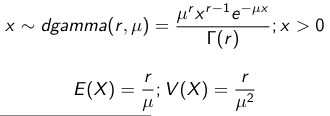
We use a Normal prior distribution for the mean <span dir="ltr" role="presentation" style="left: 15.7%; top: 47.91%; font-size: calc(var(--scale-factor)*9.96px); font-family: sans-serif;">β</span><sub><span dir="ltr" role="presentation" style="left: 17.25%; top: 49.3%; font-family: sans-serif;">0</span></sub><span dir="ltr" role="presentation" style="left: 20.83%; top: 47.91%; font-size: calc(var(--scale-factor)*9.96px); font-family: sans-serif;"> </span><span dir="ltr" role="presentation" style="left: 21.9%; top: 47.91%; font-size: calc(var(--scale-factor)*9.96px); font-family: sans-serif;">∼</span><span dir="ltr" role="presentation" style="left: 24.04%; top: 47.91%; font-size: calc(var(--scale-factor)*9.96px); font-family: sans-serif;"> </span><span dir="ltr" role="presentation" style="left: 24.8%; top: 47.91%; font-size: calc(var(--scale-factor)*9.96px); font-family: sans-serif;">N</span><span dir="ltr" role="presentation" style="left: 26.96%; top: 47.91%; font-size: calc(var(--scale-factor)*9.96px); font-family: sans-serif;">(<span dir="ltr" role="presentation" style="left: 63.65%; top: 63.14%; font-size: calc(var(--scale-factor)*9.96px); font-family: sans-serif;">μ</span></span><sub><span dir="ltr" role="presentation" style="left: 29.58%; top: 49.3%; font-family: sans-serif;">0</span></sub><span dir="ltr" role="presentation" style="left: 30.74%; top: 47.91%; font-size: calc(var(--scale-factor)*9.96px); font-family: sans-serif; transform: scaleX(0.799684);">, </span><span dir="ltr" role="presentation" style="left: 39.82%; top: 47.91%; font-size: calc(var(--scale-factor)*9.96px); font-family: sans-serif; transform: scaleX(0.997537);">τ<sub>0</sub></span><span dir="ltr" role="presentation" style="left: 42.71%; top: 47.91%; font-size: calc(var(--scale-factor)*9.96px); font-family: sans-serif;">) and a **Gamma** prior distribution for the precision parameter:  
</span>[![image.png](https://bookstack.mitchellhenschel.com/uploads/images/gallery/2023-02/scaled-1680-/0Drimage.png)](https://bookstack.mitchellhenschel.com/uploads/images/gallery/2023-02/0Drimage.png)

JAGS example:

```
model.1 <- "model {
	for (i in 1:N) {
		hbf[i] ~ dnorm(b.0,tau.t)
	}
	## prior on precision parameters
	tau.t ~ dgamma(1,1);
	### prior on mean given precision
	mu.0 <- 5
	tau.0 <- 0.44
	b.0 ~ dnorm(mu.0, tau.0);
    
    ### prediction
	hbf.new ~ dnorm(b.0,tau.t)
	pred <- step(hbf.new-20) # hbf >= 20
}"
```

#### Predictive Distributions

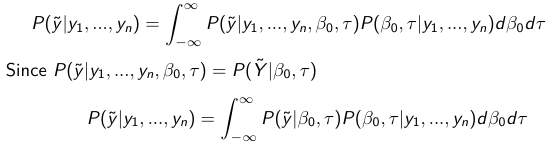
Given the Prior and Observed data we can compute the probability of a new observation will be greater or less than some integer threshold. The predictive distribution is a distribution of unobserved y<sup>~</sup>, that is:  
[![image.png](https://bookstack.mitchellhenschel.com/uploads/images/gallery/2023-02/scaled-1680-/7xDimage.png)](https://bookstack.mitchellhenschel.com/uploads/images/gallery/2023-02/7xDimage.png)

The two sources of variability in prediction are in the parameters V(<span dir="ltr" role="presentation" style="left: 34.36%; top: 24.8%; font-size: calc(var(--scale-factor)*9.96px); font-family: sans-serif;">β</span><sub>0</sub>, <span dir="ltr" role="presentation" style="left: 7.32%; top: 34.44%; font-size: calc(var(--scale-factor)*9.96px); font-family: sans-serif;">τ | y) and the variability in the new observation V(y | <span dir="ltr" role="presentation" style="left: 34.36%; top: 24.8%; font-size: calc(var(--scale-factor)*9.96px); font-family: sans-serif;">β</span><sub>0</sub>, <span dir="ltr" role="presentation" style="left: 7.32%; top: 34.44%; font-size: calc(var(--scale-factor)*9.96px); font-family: sans-serif;">τ</span>)</span>

- <span dir="ltr" role="presentation" style="left: 7.32%; top: 34.44%; font-size: calc(var(--scale-factor)*9.96px); font-family: sans-serif;">To simulate from predictive density, do repeatedly:</span>
    1. <span dir="ltr" role="presentation" style="left: 7.32%; top: 34.44%; font-size: calc(var(--scale-factor)*9.96px); font-family: sans-serif;">Sample one sample <span dir="ltr" role="presentation" style="left: 34.36%; top: 24.8%; font-size: calc(var(--scale-factor)*9.96px); font-family: sans-serif;">β</span><sub>0</sub><sup>\*</sup>, <span dir="ltr" role="presentation" style="left: 7.32%; top: 34.44%; font-size: calc(var(--scale-factor)*9.96px); font-family: sans-serif;">τ\* from posterior <span dir="ltr" role="presentation" style="left: 34.36%; top: 24.8%; font-size: calc(var(--scale-factor)*9.96px); font-family: sans-serif;">β</span><sub>0</sub>, <span dir="ltr" role="presentation" style="left: 7.32%; top: 34.44%; font-size: calc(var(--scale-factor)*9.96px); font-family: sans-serif;">τ | y</span></span></span>
    2. <span dir="ltr" role="presentation" style="left: 7.32%; top: 34.44%; font-size: calc(var(--scale-factor)*9.96px); font-family: sans-serif;"><span dir="ltr" role="presentation" style="left: 7.32%; top: 34.44%; font-size: calc(var(--scale-factor)*9.96px); font-family: sans-serif;"><span dir="ltr" role="presentation" style="left: 7.32%; top: 34.44%; font-size: calc(var(--scale-factor)*9.96px); font-family: sans-serif;">Sample one y<sup>~</sup> ~ N(<span dir="ltr" role="presentation" style="left: 34.36%; top: 24.8%; font-size: calc(var(--scale-factor)*9.96px); font-family: sans-serif;">β</span><sub>0</sub><sup>\*</sup>, 1/<span dir="ltr" role="presentation" style="left: 7.32%; top: 34.44%; font-size: calc(var(--scale-factor)*9.96px); font-family: sans-serif;">τ\* )</span></span></span></span>
- <span dir="ltr" role="presentation" style="left: 7.32%; top: 34.44%; font-size: calc(var(--scale-factor)*9.96px); font-family: sans-serif;"><span dir="ltr" role="presentation" style="left: 7.32%; top: 34.44%; font-size: calc(var(--scale-factor)*9.96px); font-family: sans-serif;"><span dir="ltr" role="presentation" style="left: 7.32%; top: 34.44%; font-size: calc(var(--scale-factor)*9.96px); font-family: sans-serif;"><span dir="ltr" role="presentation" style="left: 7.32%; top: 34.44%; font-size: calc(var(--scale-factor)*9.96px); font-family: sans-serif;">During the Gibbs sampling we generate samples values from the posterior distribution <span dir="ltr" role="presentation" style="left: 7.32%; top: 34.44%; font-size: calc(var(--scale-factor)*9.96px); font-family: sans-serif;"><span dir="ltr" role="presentation" style="left: 7.32%; top: 34.44%; font-size: calc(var(--scale-factor)*9.96px); font-family: sans-serif;"><span dir="ltr" role="presentation" style="left: 34.36%; top: 24.8%; font-size: calc(var(--scale-factor)*9.96px); font-family: sans-serif;">β</span><sub>0</sub>, <span dir="ltr" role="presentation" style="left: 7.32%; top: 34.44%; font-size: calc(var(--scale-factor)*9.96px); font-family: sans-serif;">τ | y</span></span></span></span></span></span></span>
- <span dir="ltr" role="presentation" style="left: 7.32%; top: 34.44%; font-size: calc(var(--scale-factor)*9.96px); font-family: sans-serif;"><span dir="ltr" role="presentation" style="left: 7.32%; top: 34.44%; font-size: calc(var(--scale-factor)*9.96px); font-family: sans-serif;"><span dir="ltr" role="presentation" style="left: 7.32%; top: 34.44%; font-size: calc(var(--scale-factor)*9.96px); font-family: sans-serif;"><span dir="ltr" role="presentation" style="left: 7.32%; top: 34.44%; font-size: calc(var(--scale-factor)*9.96px); font-family: sans-serif;"><span dir="ltr" role="presentation" style="left: 7.32%; top: 34.44%; font-size: calc(var(--scale-factor)*9.96px); font-family: sans-serif;"><span dir="ltr" role="presentation" style="left: 7.32%; top: 34.44%; font-size: calc(var(--scale-factor)*9.96px); font-family: sans-serif;"><span dir="ltr" role="presentation" style="left: 7.32%; top: 34.44%; font-size: calc(var(--scale-factor)*9.96px); font-family: sans-serif;">So Generating y<sup>~</sup> ~ N(<span dir="ltr" role="presentation" style="left: 7.32%; top: 34.44%; font-size: calc(var(--scale-factor)*9.96px); font-family: sans-serif;"><span dir="ltr" role="presentation" style="left: 7.32%; top: 34.44%; font-size: calc(var(--scale-factor)*9.96px); font-family: sans-serif;"><span dir="ltr" role="presentation" style="left: 34.36%; top: 24.8%; font-size: calc(var(--scale-factor)*9.96px); font-family: sans-serif;">β</span><sub>0</sub>, <span dir="ltr" role="presentation" style="left: 7.32%; top: 34.44%; font-size: calc(var(--scale-factor)*9.96px); font-family: sans-serif;">τ | y) will produce the correct predictive distribution samples. P(y<sup>~</sup> &gt; 20 | data) is the proportion of y<sup>~</sup> &gt; 20</span></span></span></span></span></span></span></span></span></span>

#### Log Normal Distributions  


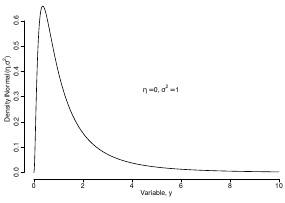
Since in the example above the outcome distribution can only be positive we can use a Log-Normal distribution, a continuous distribution with support for values y &gt; 0.

[![image.png](https://bookstack.mitchellhenschel.com/uploads/images/gallery/2023-02/scaled-1680-/vEWimage.png)](https://bookstack.mitchellhenschel.com/uploads/images/gallery/2023-02/vEWimage.png)  
Y | η, σ<sup>2</sup> ~ INormal(η, σ<sup>2</sup>) with density function:  
[![image.png](https://bookstack.mitchellhenschel.com/uploads/images/gallery/2023-02/scaled-1680-/ye6image.png)](https://bookstack.mitchellhenschel.com/uploads/images/gallery/2023-02/ye6image.png)

[![image.png](https://bookstack.mitchellhenschel.com/uploads/images/gallery/2023-02/scaled-1680-/NX5image.png)](https://bookstack.mitchellhenschel.com/uploads/images/gallery/2023-02/NX5image.png)
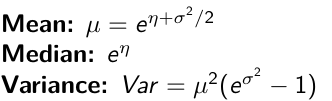
It also implies: Log( Y )~ Normal(η, σ<sup>2</sup>)

In JAGS we use: dlnorm(η, σ<sup>2</sup>)

```
"model {
for (i in 1:N) {
	hbf[i] ~ dlnorm(lb.0,tau.t)
}

## prior on precision parameters
tau.t ~ dgamma(1,1);

### prior on mean
lb.0 ~ dnorm(1.6,1.6);

b.0 <- exp(lb.0)

### prediction
hbf.new ~ dlnorm(lb.0,tau.t)
pred <- step(hbf.new-20)
}"
```

In the above example, we get the initial prior on <span dir="ltr" role="presentation" style="left: 34.36%; top: 24.8%; font-size: calc(var(--scale-factor)*9.96px); font-family: sans-serif;">β</span><sub>0 </sub>from previous data, where we derived median(b.0)=5 and V(b.0)=1/0.44=2.27  
Then we take the log of the median to get η and transform the precision variable with: log(1 + V (b.0)/E (b.0)<sup>2</sup> ), then take the inverse of that to get the variance.

#### Parameter Interpretation

Let's consider data of the SNP rs766432 on the effect of HbF  
[![image.png](https://bookstack.mitchellhenschel.com/uploads/images/gallery/2023-02/scaled-1680-/edaimage.png)](https://bookstack.mitchellhenschel.com/uploads/images/gallery/2023-02/edaimage.png)  
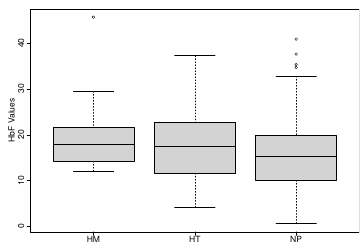
Where HT is heterzygote, HM is homozygoute and NP is common alleles.   
[![image.png](https://bookstack.mitchellhenschel.com/uploads/images/gallery/2023-02/scaled-1680-/HRIimage.png)](https://bookstack.mitchellhenschel.com/uploads/images/gallery/2023-02/HRIimage.png)
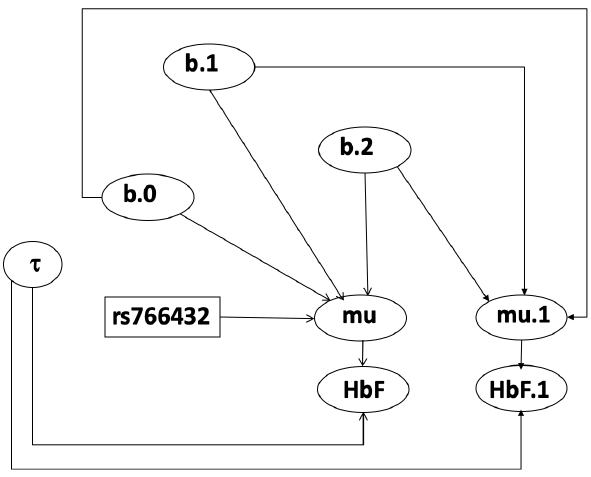
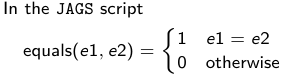
- We start by creating indicators for HT and NP using the equals( , ) function in JAGS  
    [![image.png](https://bookstack.mitchellhenschel.com/uploads/images/gallery/2023-02/scaled-1680-/iVLimage.png)](https://bookstack.mitchellhenschel.com/uploads/images/gallery/2023-02/iVLimage.png)
- The mean of Log HbF  
    [![image.png](https://bookstack.mitchellhenschel.com/uploads/images/gallery/2023-02/scaled-1680-/hd7image.png)](https://bookstack.mitchellhenschel.com/uploads/images/gallery/2023-02/hd7image.png)  
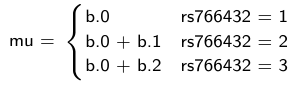
    b.1 = the effect of HT vs HM  
    b.2 = the effect of NP vs HM
- The hypotheses:  
    1. H0: b.1 = 0; HM and HT have the same effect  
    2. H0: b.2 = 0; HM and NP have the same effect

```
model.1 <- "model {
	for (i in 1:N) {
		hbf[i] ~ dlnorm(mu[i],tau.t)
		mu[i] <- b.0+b.1 *equals(rs766432[i],2)+b.2 *equals(rs766432[i],3)
	}
	## prior on precision parameters
	tau.t ~ dgamma(1,1);
	### prior on mean given precision
	b.0 ~ dnorm(0, 0.001);
	b.1 ~ dnorm(0, 0.001);
	b.2 ~ dnorm(0, 0.001);
	### prediction
	lmu.1 <- b.0;
 	hbf.1 ~ dlnorm( lmu.1,tau.t); 
    pred.1 <- step(hbf.1-20)
	lmu.2 <- b.0+b.1; 
    hbf.2 ~ dlnorm( lmu.2,tau.t); 
    pred.2 <- step(hbf.2-20)
	lmu.3 <- b.0+b.2; 
    hbf.3 ~ dlnorm( lmu.3,tau.t); 
    pred.3 <- step(hbf.3-20)
	### fitted medians by genotypes
	mu.1 <- exp(lmu.1)
	mu.2 <- exp(lmu.2)
	mu.3 <- exp(lmu.3)
	par.b[1] <- b.0;
	qpar.b[2] <- b.1;
	par.b[3] <- b.2
	par.h[1] <- hbf.1; 
    par.h[2] <- hbf.2; 
    par.h[3] <- hbf.3;
	par.m[1] <- mu.1;
	par.m[2] <- mu.2;
	par.m[3] <- mu.3
	par.p[1] <- pred.1; 
    par.p[2] <- pred.2; 
    par.p[3] <- pred.3
}"

data.1 <- source("saudi.data.2.txt")[[1]]
model_hbf <- jags.model(textConnection(model.1), data = data.1,n.adapt = 1000)
update(model_hbf, 10000)
test_hbf <- coda.samples(model_hbf, c("par.b", "par.h", "par.m","par.p"), n.iter = 10000)
summary(test_hbf)
plot(test_hbf)
autocorr.plot(test_hbf)
```

To analyze the convergence we can observe normality in auto-correlation plots. If we wee substantial auto-correlation (lag &gt; X), we can repeat the the MCMC for 100,000 simulations and sample every X steps by using thin = X in coda.samples(); where X is how often order occurs in the plot.

test\_hbf &lt;- coda.samples(model\_hbf, c("par.b", "par.h", "par.m","par.p"), n.iter = 1e+05, thin = 30)

Depending on which hypothesis we are testing we could also eliminate b.1 or b.2. Or in other situations reparameterizations can reduce correlation.

#### ANOVA Example

In this example let's consider a study of 5 different treatment groups assigned to wear shirts with differing levels of cotton (15%, 20%, 25%, 30%, and 35%) and strength was measured. We'll code these levels as dummy variables and

[![image.png](https://bookstack.mitchellhenschel.com/uploads/images/gallery/2023-02/scaled-1680-/jm7image.png)](https://bookstack.mitchellhenschel.com/uploads/images/gallery/2023-02/jm7image.png)  
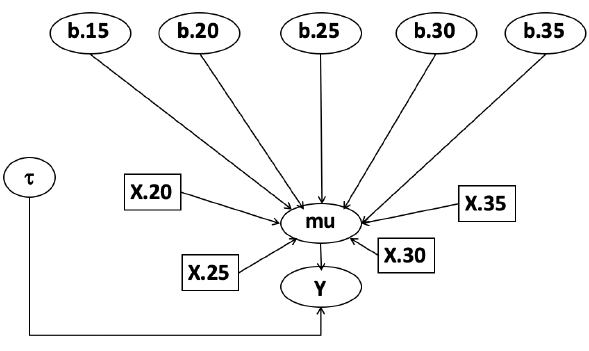
Note that since 15% is the reference group we keep it as a constant.

```
model.1 <- "model {
	### data model
	for(i in 1:N){
		y[i] ~dnorm(mu[i], tau)
		mu[i] <- b.15 + b.20*lev.20[i] +b.25 *lev.25[i] +
		b.30*lev.30[i] +b.35 * lev.35[i] 
    }
	###
	prior
	b.15 ~dnorm(0,0.0001); ## referent group
	b.20 ~dnorm(0,0.0001);
	b.25 ~dnorm(0,0.0001);
	b.30 ~dnorm(0,0.0001);
	b.35 ~dnorm(0,0.0001);
	tau ~dgamma(1,1)
	### difference in strength between level 3 (25%) and level 4 (30%)
	b.30.25 <- b.30-b.25
	### estimated strength in groups (30%)
	strength[1] <- b.15
	strength[2] <- strength[1]+b.20
	strength[3] <- strength[1]+b.25
	strength[4] <- strength[1]+b.30
	strength[5] <- strength[1]+b.35
}"
```

#### ANCOVA Example

These are models that include a continuous covariate and a categorical variable with 2 categories.  
[![image.png](https://bookstack.mitchellhenschel.com/uploads/images/gallery/2023-02/scaled-1680-/TEWimage.png)](https://bookstack.mitchellhenschel.com/uploads/images/gallery/2023-02/TEWimage.png)  

When the slope differs in the 2 groups and the lines are not parallel  
[![image.png](https://bookstack.mitchellhenschel.com/uploads/images/gallery/2023-02/scaled-1680-/tgYimage.png)](https://bookstack.mitchellhenschel.com/uploads/images/gallery/2023-02/tgYimage.png)

```
model.1 <- "model{
  ### data model
  for(i in 1:N){
      hbf_after[i] ~dlnorm(mu[i],tau)
      Lhbf_baseline[i] <- log(hbf_baseline[i])
      mu[i] <- beta.0 + beta.d*Drug[i] +
      beta.b*(Lhbf_baseline[i]-mean(Lhbf_baseline[])) +
      beta.i*Drug[i] *(Lhbf_baseline[i]-mean(Lhbf_baseline[]))
  }
  ### prior density
  beta.0 ~ dnorm(0,0.0001)
  beta.d ~dnorm(0, 0.0001)
  beta.b ~dnorm(0, 0.0001)
  beta.i ~dnorm(0,0.0001)
  tau ~ dgamma(1,1);
  ### inference
  parameter[1] <- beta.0
  parameter[2] <- beta.d
  parameter[3] <- beta.b
  parameter[4] <- beta.i
}"
### generate data
Drug = rep(0, nrow(hbf.data))
Drug[treatment == "Hy"] <- 1
table(Drug, hbf.data$Drug)
data.1 <- list(N = as.numeric(nrow(hbf.data)), hbf_baseline = hbf_baseline, hbf_after = hbf_after, Drug = Drug)
model_mean <- jags.model(textConnection(model.1), data = data.1,n.adapt = 1000)
update(model_mean, 10000)
test_mean <- coda.samples(model_mean, c("parameter"), n.iter = 10000)
```

So if the interaction term is significant then we would conclude the treatment has an effect

#### Missing Values

Treat missing values in the response as unknown parameters and JAGS will generate them as a form of imputation. Missing data in the covariates however is not so easy.

#### Model Selection: DIC

- Model selection based on marginal likelihood is most robust but difficult to implement
- Often model search over many models is based on BIC using posterior estimates of parameters
- Model selection for a small number of models is based on posterior intervals

Start from the deviance: -2log(P(y | β, τ ))

Deviance information Criterion:  
DIC = Dbar + pD = Dhat + 2 \* pD

Dbar: -2 E(log(P(y | β, τ ))) = posterior mean of the deviance  
Dhat: -2 log(P(y | β^, τ^ ) = point estimate of the deviance using the posterior means of the parameters  
pD: Dbar - Dhat = Effective number of parameters

The model with the smallest DIC is estimated to be the model that would best predict a replicate dataset of the same structure as the observed.