# Module 3: Random Variables and Normal Distributions
A **variable** is a measurement or characteristic on which individual observations are made. A **random** **variable** is a variable whose possible values are outcomes of a random phenomenon. A **domain** is a set of all possible values a variable can take.
Discrete random variables is a finite set or countably infinite sequence.
px(xi) = P(X = xI) is called the **Probability Mass Function** (PMF).
- 0 <= px(xi) <= 1 as it is a probability,
- Sum of PMF for all values of X = 1.
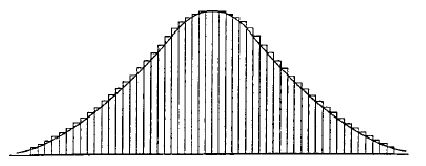
Continuous random variable can lie on a numerical scale, such as all real numbers between (0, +infinity). If we mapped the data to a histogram, we would see the curve begin to smooth as the number of data points approaches infinity.
[](https://bookstack.mitchellhenschel.com/uploads/images/gallery/2022-08/image-1660746198461.png)
This density curve, fx(x), is called the **Probability Density Function** (PDF).
- fx(x) >= 0 but can be greater than 1
- The integral of fx(x) over the domain of X is 1
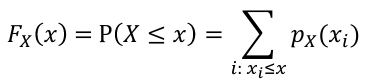
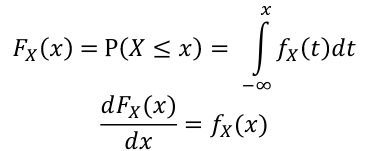
The **Cumulative Distribution Function** (CDF) is defined as Fx(X) = P(X <= x)
- Non-decreasing
- The limit toward -infinity is 0, toward +infinity is 1
- For discrete random variables:
[](https://bookstack.mitchellhenschel.com/uploads/images/gallery/2022-08/image-1660746730973.png)
- For continuous random variables:
[](https://bookstack.mitchellhenschel.com/uploads/images/gallery/2022-08/image-1660746747252.png)
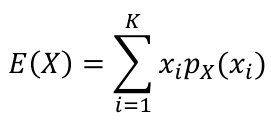
The **Expected Value** of a random variable is an average of the possible values weighted by their probabilities. Also called mean and denoted by μ.
- For discrete random variables
[](https://bookstack.mitchellhenschel.com/uploads/images/gallery/2022-08/image-1660746888477.png)
- For continuous random variables
[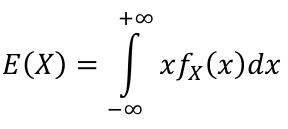](https://bookstack.mitchellhenschel.com/uploads/images/gallery/2022-08/image-1660746926437.png)
A generalization for the expected values is the **rth moment of a random variables**, R(Xr).
- For discrete random variables:
[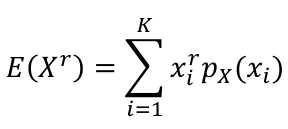](https://bookstack.mitchellhenschel.com/uploads/images/gallery/2022-08/image-1660748084163.png)
- For continuous random variables:
[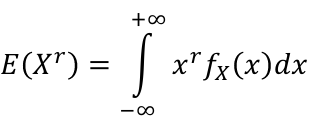](https://bookstack.mitchellhenschel.com/uploads/images/gallery/2022-08/image-1660748094182.png)
The first moment of a random variable is the expect value (mean). The rth moment of a random variable about the mean, also called the rth central moment, is defined as: E\[(X - μ)r\]
- The first central moment = 0
- The second central moment is the variance denoted as 𝜎2
The **variance** measures the spread around the mean of a random variable: Var(X) = E\[(X - μ)2\]
- Also equivelent to Var(X) = E(X2) - \[E(X)\]2
- The standard deviation is the square root of the variance
The **normal distribution:**
- is a continuous distribution
- can be expressed by a formula
- also called Gaussian distribution
- is a theoretical model for a population distribution that approximates the distribution of a number of measurement variables
- is appropriate for a number of measures, but not all. Only appropriate for some continuous measurements.
- is symmetric about the mean (i.e P(X > μ) = P(X < μ) = .5)
- is completely characterized mean and variance
The 68/95/99 rule:
- 68.25% of the data falls within 1 SD
- 95.45% of the data falls within 2 SD
- 99.74% of the data falls within 3SD
The standard normal random variable, referred to as Z, is in the scale of SD units from the mean.
Z has a μ=0 and SD = 1 we can standardize any normal distribution with:
[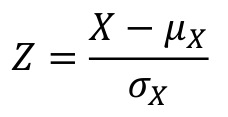](https://bookstack.mitchellhenschel.com/uploads/images/gallery/2022-08/image-1660749009432.png)
By converting to Z-scores we can easily compare the probability events in two different normal distribution.
The kth percentile is defined as the score that holds the k percent of the scores below it. Ex. 90th percentile is the score that has 90% of the scores below it. We can compute percentiles with: X = μ + Z𝜎
The probability density function for normal curves:
[](https://bookstack.mitchellhenschel.com/uploads/images/gallery/2022-08/image-1660750388639.png)
And in normal curves when mean is 0 and SD is 1 this can be simplified.
#### Relevant R Functions
**qnorm(**percentile, μ, 𝜎) computes percentiles for normal variables
**dnorm(**x, μ, 𝜎) will return the height of normal density function with a certain mean and SD at point x
**pnorm(**z, μ, 𝜎) will return the cumulative distribution function of a normal distribution with certain mean and SD